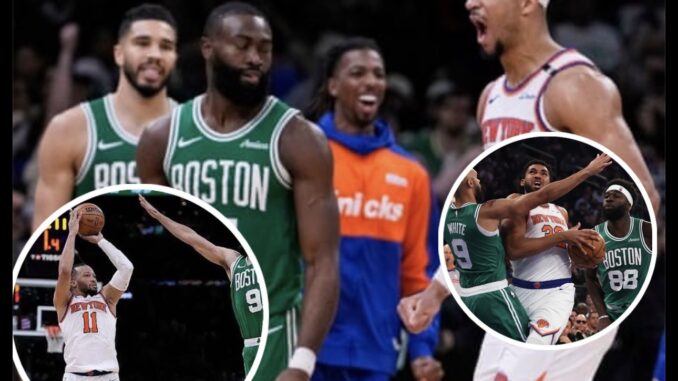
If you were sitting inside TD Garden — or watching from your couch — you probably felt it long before the final buzzer.
That sinking feeling.
That quiet disbelief.
That “this can’t really be happening” moment.
The Boston Celtics didn’t just lose to the New York Knicks. They were run out of their own building, falling 111–89 in a game that was ugly, frustrating, and honestly hard to watch if you care about this team.
For a group that’s supposed to be chasing banners, this didn’t look like a contender. It looked like a team that got punched in the mouth… and never punched back.
This Wasn’t Just a Bad Night — It Was a No-Show
Let’s be clear: every NBA team has off nights. Shots don’t fall. Legs feel heavy. It happens.
But this?
This was different.
Boston never found a rhythm. Never controlled the pace. Never made the Knicks uncomfortable. From the opening tip, New York looked sharper, stronger, and far more locked in.
By the time the fourth quarter rolled around, the outcome felt inevitable. The Knicks were cruising. Celtics fans were quiet. And the scoreboard told a brutal story: down more than 20 points at home.
That’s not a cold shooting night.
That’s a problem.
The Score Hurt — The Way It Happened Hurt More
An 89-point performance in today’s NBA is alarming enough. Doing it at home makes it worse. Doing it while trailing almost the entire game makes it embarrassing.
Boston’s offense felt stiff and predictable:
- Too much standing around
- Too many rushed jumpers
- Too little movement and creativity
Possessions ended with frustration instead of confidence. You could see it on the players’ faces — hands on hips, heads shaking, shoulders slumping.
Meanwhile, the Knicks were calm. Poised. Comfortable.
In TD Garden.
That alone should set off alarms.
Where Was the Urgency?
Here’s the part that Celtics fans will struggle with the most.
When things started going south, there was no visible urgency. No stretch where Boston said, “Enough. This stops now.”
Championship teams have those moments. They flip a switch. They lock in defensively. They make the game ugly if they have to.
Boston didn’t.
Instead, the Knicks kept winning the small battles:
- Loose balls
- Rebounds
- Physical possessions
New York played like the team with something to prove. Boston played like the team expecting things to just work out.
They didn’t.
Stars Are Supposed to Change the Energy
Every contender leans on its stars when things get uncomfortable. That’s not criticism — that’s reality.
And on this night, the Celtics never got that momentum-shifting stretch where a star took over, lifted the building, and dragged the team back into the fight.
There were flashes, sure. But flashes aren’t enough when the game is slipping away.
What was missing wasn’t talent — it was assertiveness.
When your season goals include a championship, disappearing stretches can’t happen. Not like this. Not at home.
Defense, Once a Strength, Looked Lost
Boston has built its reputation on defense. Length. Switching. Physicality.
Against the Knicks?
It just wasn’t there.
New York got clean looks. They attacked gaps. They punished late rotations. And they did it without panicking or forcing anything.
The Celtics looked a step slow — mentally and physically. Communication broke down. Closeouts were late. Help defense arrived after the damage was done.
When your defense isn’t saving you, everything else starts to unravel.
And it did.
TD Garden Went Quiet — That Says Everything
If you want to understand how bad this felt, listen to the crowd.
TD Garden doesn’t usually go silent unless something has gone very wrong. By the second half, the buzz was gone. The energy drained. Fans weren’t angry — they were disappointed.
That’s worse.
Home court is supposed to be an advantage. On this night, it felt meaningless.
The Knicks didn’t just win. They got comfortable. They played freely. They acted like they belonged there.
Boston let them.
Credit Where It’s Due: The Knicks Were Excellent
This wasn’t a fluke.
The Knicks executed their game plan beautifully. They were disciplined, physical, and unselfish. They didn’t rely on one player going nuclear — they relied on team basketball.
They controlled the tempo. They made Boston work for everything. And when the Celtics made mistakes, New York punished them.
That’s how you steal a road game.
That’s how you embarrass a contender.
Is This Just One Loss — Or a Bigger Warning?
This is the uncomfortable part.
One loss doesn’t define a season. But how you lose can reveal a lot.
This game raised real questions:
- Why did Boston struggle to respond?
- Why did the intensity never rise?
- Why did the Knicks look tougher in every meaningful moment?
These are the types of questions that linger — especially when the playoffs come around and there’s nowhere to hide.
Talent alone won’t save you in May and June.
Pressure Is Building — Fair or Not
With expectations comes pressure. That’s the price of being good.
Losses like this feed doubts:
- Are the Celtics mentally strong enough?
- Do they have the edge championship teams need?
- Will they respond when the game gets uncomfortable?
These narratives won’t disappear overnight. The Celtics will have to answer them on the floor.
Talking won’t fix this.
Effort will.
What Happens Next Matters More Than This Loss
Here’s the good news: the season continues.
The Celtics still have time to respond. Still have time to tighten things up. Still have time to prove this was just a bad night — not a bad sign.
But the response has to be immediate.
Fans don’t expect perfection.
They expect fight.
If Boston comes out sharper, tougher, and more connected in the next stretch, this loss becomes a wake-up call.
If not?
It becomes a warning we should’ve taken seriously.
Final Thought: Contenders Don’t Get a Pass for Nights Like This
There’s no sugarcoating it.
An 89–111 home loss is embarrassing — especially for a team with championship aspirations. It exposed flaws that can’t be ignored and questions that won’t go away on their own.
The Celtics are good. Everyone knows that.
Now they have to show they’re tough, focused, and hungry enough to respond.
Because banners aren’t won in February — but they are lost when nights like this become a habit.
And in Boston, patience is already wearing thin. 🏀🔥
Leave a Reply